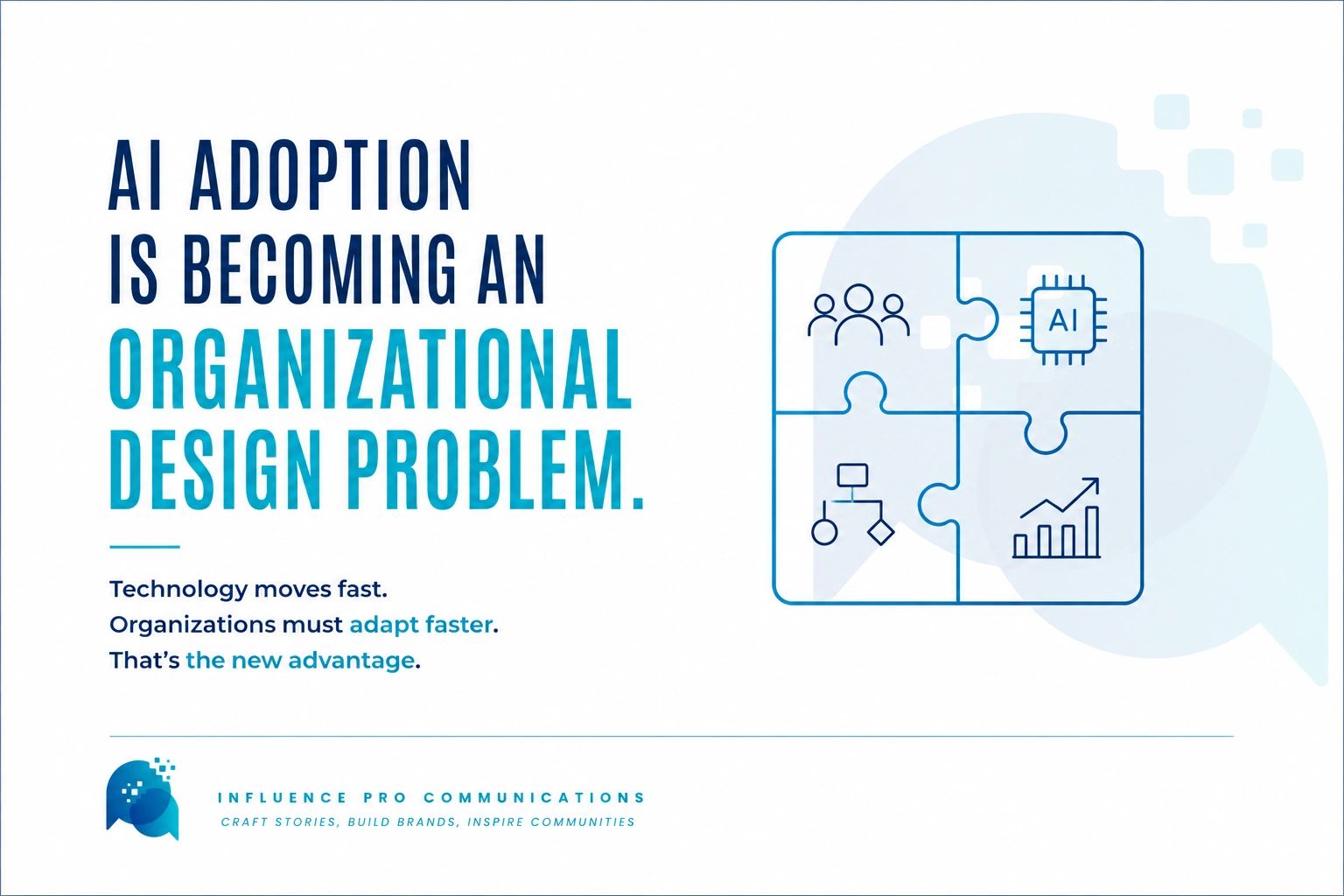
The next phase of AI won’t be won by organizations with the most tools. It will be won by organizations that can redesign how work gets done.
For the past two years, much of the conversation around enterprise AI has focused on technology.
Which model should we use? Which platform? Should we build or buy? What can we automate? How much productivity can we gain?
Those are legitimate questions. But increasingly, they are not the most important ones.
The harder question is becoming:
Can the organization actually change fast enough to take advantage of what the technology can now do?
That is a very different challenge.
The technology is moving faster than the organization
AI capabilities are advancing at a remarkable pace. But most organizations were not designed to absorb continuous technological change.
They were designed around relatively stable roles, reporting structures, workflows, approval processes and annual planning cycles.
AI challenges all of those assumptions.
When an AI system can suddenly perform part of a job that previously required several hours of human effort, simply giving employees access to the technology doesn't necessarily create value.
Someone has to reconsider the workflow.
Who does what?
Which steps are still necessary?
Where does human judgment matter?
What should be automated?
What new skills are required?
Who is accountable for the output?
And perhaps most importantly: what should the organization stop doing?
That is organizational design, not software implementation.
Adoption is not the same as access
There is another distinction executives need to recognize.
Giving employees access to AI does not mean the organization has adopted AI.
Employees experimenting with ChatGPT, Copilot or other tools may improve individual productivity. That can be valuable.
But enterprise-level value emerges when AI becomes integrated into the way the organization operates.
That means redesigning processes, decision systems, roles, measurements and management practices around new capabilities.
The difference is significant.
One organization may have 5,000 employees using AI tools.
Another may have only 500 people using AI — but has redesigned ten critical workflows that materially improve cost, speed, customer experience or decision quality.
The second organization may actually be much further ahead.
The management challenge is changing
This also changes the leadership conversation.
The question is no longer simply:
“What is our AI strategy?”
It increasingly becomes:
“How adaptable is our organization?”
Can we identify emerging technologies early?
Can we determine where they create meaningful value?
Can we redesign work around them?
Can people develop the necessary capabilities quickly?
Can governance evolve without becoming an obstacle?
Can leadership make decisions before certainty exists?
And can the organization repeat that process continuously?
Because AI will not be the last disruption.
Agents, robotics, new interfaces, increasingly autonomous systems and technologies we haven't yet anticipated will continue changing what organizations are capable of doing.
The organizations that thrive may therefore have one capability in common:
They become very good at changing themselves.
From digital transformation to organizational adaptability
For years, companies talked about digital transformation as though transformation were a project with a beginning and an end.
That model is becoming increasingly difficult to sustain.
There may no longer be a stable destination to transform to.
Instead, organizations need the capability to continuously evaluate emerging technology, redesign work and deploy new operating models.
That is why I believe Organizational Adaptability is becoming one of the defining management capabilities of the AI economy.
Technology matters.
Strategy matters.
But increasingly, competitive advantage will belong to organizations capable of translating technological possibility into organizational performance — repeatedly, quickly and responsibly.
The AI race may ultimately be less about who has the best technology and more about who has built the organization most capable of using it.
Paul McCrea
Influence Pro Research™