
By Paul McCrea
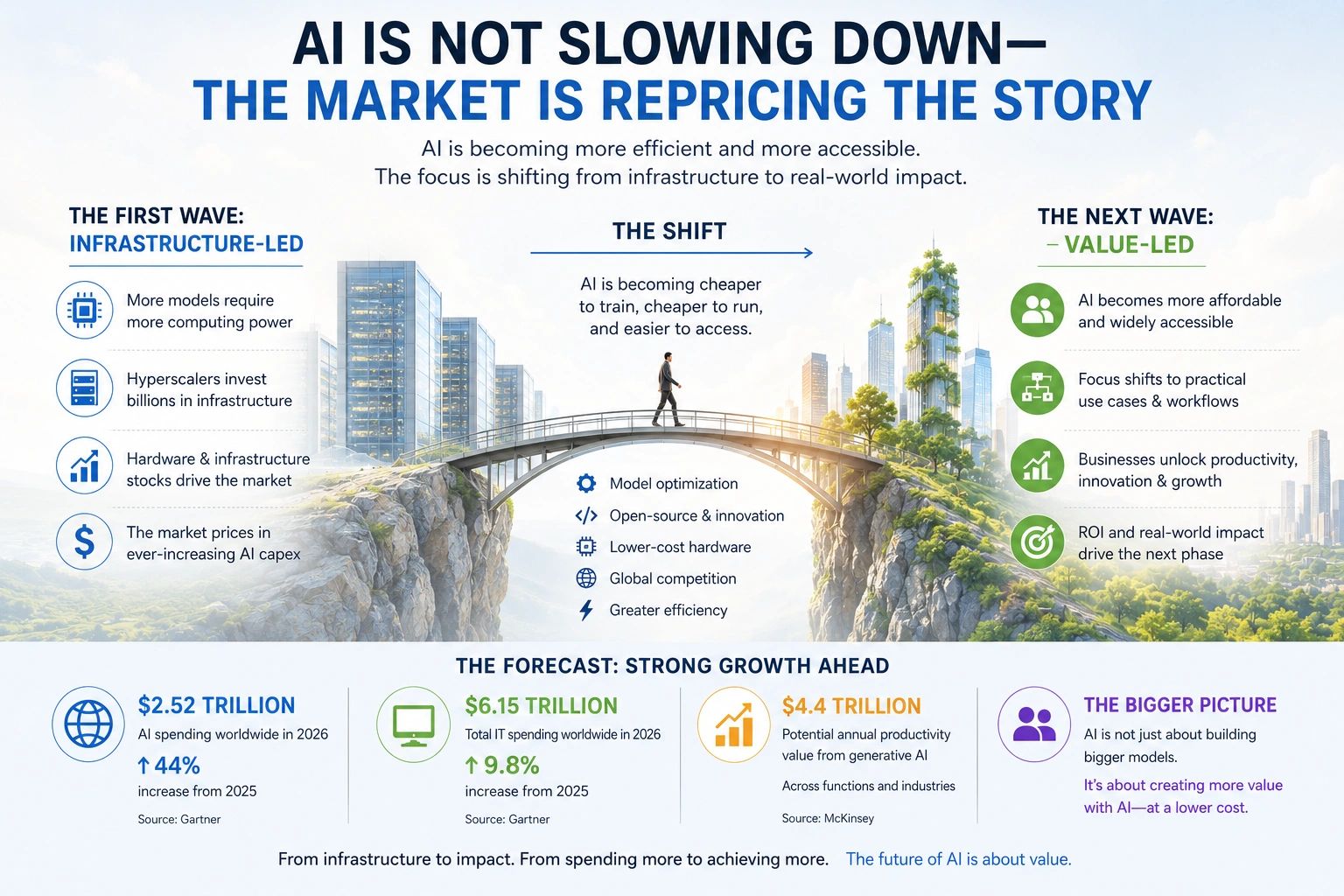
For the past two years, the artificial intelligence market has been driven by one powerful idea: bigger models require more computing power, more chips, more data centres, and more capital spending.
That story is not wrong. But it may now be incomplete.
Recent market commentary from Goldman Sachs points to a growing divide between the companies building AI infrastructure and the companies expected to profit from using it. The concern is not that AI demand is disappearing. In fact, demand continues to grow. The concern is that AI may become cheaper, faster, and more efficient more quickly than the market expected.
That creates a very different investment and business story.
The AI Market Is Entering a More Complicated Phase
The first phase of the AI boom was infrastructure-led. Nvidia, semiconductor manufacturers, server companies, and data centre operators became the clear winners because every major AI platform needed more computing power.
The largest technology companies including Amazon, Microsoft, Google, Meta and others, committed enormous capital to AI infrastructure. That spending created confidence across the market that AI-related demand would keep rising.
But the next phase may not be as simple.
If AI models become cheaper to train and cheaper to run, then the market has to ask a harder question: how much infrastructure is actually needed?
That is where the “rubber band” analogy becomes useful. On one side, hardware and infrastructure stocks have priced in continued capital spending. On the other side, software development, model optimization, quantization, orchestration, open-source models, and lower-cost international competitors are all making AI less expensive to deploy.
At some point, those two realities may pull too far apart.
Cheaper AI Is Not Bad News
This is the most important point.
Cheaper AI is not a sign that AI is failing. It may be a sign that AI is maturing.
Most transformative technologies become more useful when they become less expensive. Computing, cloud storage, internet bandwidth, digital cameras, and smartphones all followed versions of this pattern. The cost of the underlying technology fell, while adoption expanded.
AI may follow the same path.
The early winners were the companies selling the picks and shovels. The next wave may favour the companies that use AI to improve productivity, reduce costs, improve customer experience, accelerate research, or create better decision-making.
In other words, the market may shift from “who owns the most computing power?” to “who creates the most value with AI?”
The Forecasts Still Point to Massive Growth
Even with market volatility, the AI growth forecasts remain significant.
Gartner forecasts worldwide AI spending of roughly $2.5 trillion in 2026, a major increase from 2025. Total IT spending is also expected to continue growing, with AI infrastructure remaining one of the strongest drivers.
McKinsey has estimated that generative AI could eventually add trillions of dollars in annual productivity value across business functions, especially in areas like customer operations, software development, marketing, sales, research, and knowledge work.
The message is clear: AI is not going away.
But the value may move.
What Could Change Going Forward
There are several likely developments to watch.
First, AI infrastructure spending may remain high, but investors may become more selective. The market may begin asking whether every new data centre or chip order will produce enough return.
Second, software and workflow adoption may become more important. As AI tools become cheaper and easier to use, more organizations will move from experimentation to practical implementation.
Third, pricing power may shift. If lower-cost models become “good enough” for many business uses, premium model providers may face pressure.
Fourth, governance and training will matter more. As more teams use AI, organizations will need clearer rules, stronger workflows, better measurement, and practical education.
Fifth, the focus will move from hype to ROI. Businesses will increasingly ask: What problem does this solve? What time does it save? What cost does it reduce? What new capability does it create?
The Real Opportunity
The AI opportunity is no longer just about building the biggest model.
For most businesses, the opportunity is much more practical:
Can AI help teams write better?
Can it improve research?
Can it support customer service?
Can it speed up planning?
Can it reduce repetitive work?
Can it help leaders make better decisions?
Can it create measurable productivity gains?
That is where the next phase of AI adoption will likely be won.
Final Thought
The market may be starting to separate AI hype from AI value.
That is healthy.
AI infrastructure will remain important. Chips, data centres, cloud platforms, and advanced models will continue to matter. But the bigger long-term story may be the spread of AI into ordinary business processes.
The winners may not simply be the companies that spend the most on AI.
The winners may be the companies that learn how to use it well.