By Paul McCrea
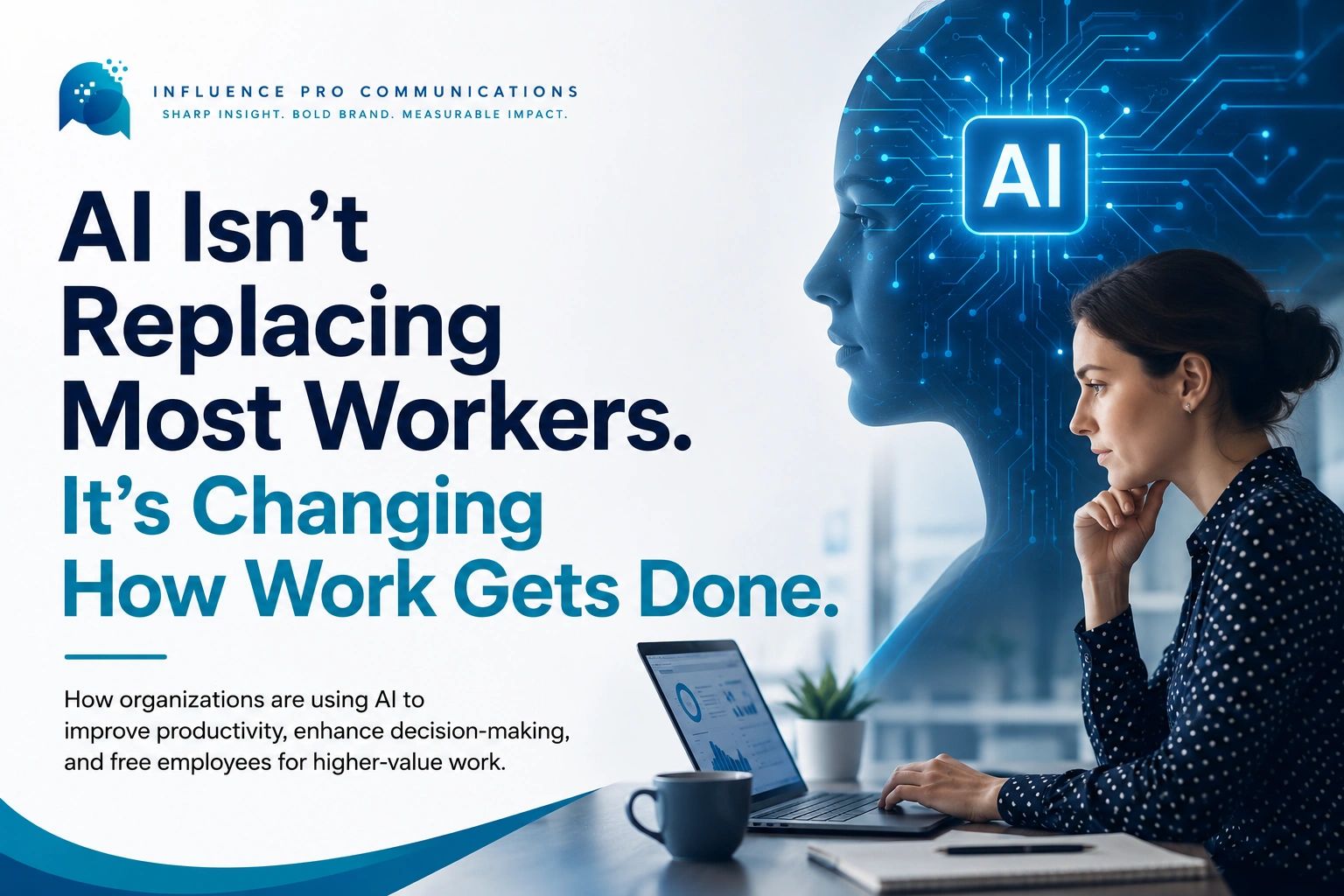
Artificial intelligence has become one of the most discussed technologies in modern business. While concerns about job displacement dominate many headlines, the reality inside most organizations is more nuanced. Rather than replacing entire workforce, AI is increasingly being used to improve productivity, automate repetitive tasks, and help employees focus on higher-value work.
The challenge for professionals and organizations is not whether AI will have an impact. It is understanding how to use the technology effectively while continuing to rely on the uniquely human skills that drive innovation, leadership, and sound decision-making.,
Here are a few observations from what we're seeing in the marketplace today.
Few technologies in recent history have generated as much excitement, and anxiety, as artificial intelligence.
For some, AI represents an extraordinary opportunity to improve productivity, accelerate innovation, and unlock new possibilities. For others, it represents a threat to jobs, careers, and the value of human expertise.
The reality is more nuanced.
While headlines often focus on job displacement, most AI deployments today are enhancing productivity rather than replacing entire work forces. Organizations are using AI to automate repetitive tasks, summarize information, generate drafts, analyze data, support customer service, and help employees complete work more efficiently. In many cases, the technology is acting as an assistant rather than a replacement.
History provides useful context. The introduction of spreadsheets did not eliminate accountants. Email did not eliminate administrative professionals. The internet did not eliminate marketing departments. Instead, these technologies changed how work was performed and shifted the skills required to succeed.
Artificial intelligence appears to be following a similar path.
The greatest value often comes when AI is paired with human judgment. An AI application may produce a draft report in seconds, but it still takes experience to evaluate the quality of the information, understand the business context, and make strategic decisions. Technology can accelerate execution, but it cannot replace accountability, leadership, creativity, ethics, or human relationships.
This distinction is important because many professionals are approaching AI with understandable skepticism. Some would prefer to see the technology disappear entirely. The concern is often rooted in legitimate fears about employment, privacy, misinformation, and the pace of change.
However, resisting AI is unlikely to stop its adoption.
A more productive approach is to understand it, evaluate it critically, and learn where it can create value. The professionals who thrive over the next decade will not necessarily be those who become AI experts. They will be those who learn how to combine technology with uniquely human strengths such as communication, critical thinking, adaptability, empathy, and leadership.
Organizations face a similar challenge. The goal should not be to deploy AI for its own sake. The goal should be to identify workflows where technology can reduce repetitive work, improve efficiency, and free people to focus on higher-value activities.
The most successful AI implementations are not about replacing people. They are about helping people spend less time on routine tasks and more time on solving problems, building relationships, creating ideas, and making decisions.
In that sense, the future may belong not to artificial intelligence alone, but to those who learn how to work intelligently alongside it.
Preparing for the future isn't about keeping pace with change. It's about learning to lead it.
The Question Isn't Whether AI Will Change Work
The question is whether we will adapt alongside it.
The professionals and organizations that succeed won't be those who ignore AI or fear it. They'll be those who learn where it creates value, where human judgment remains essential, and how the two can work together.
If you're ready to build those skills, explore our AI Adaptability courses and resources at Influence Pro Communications.