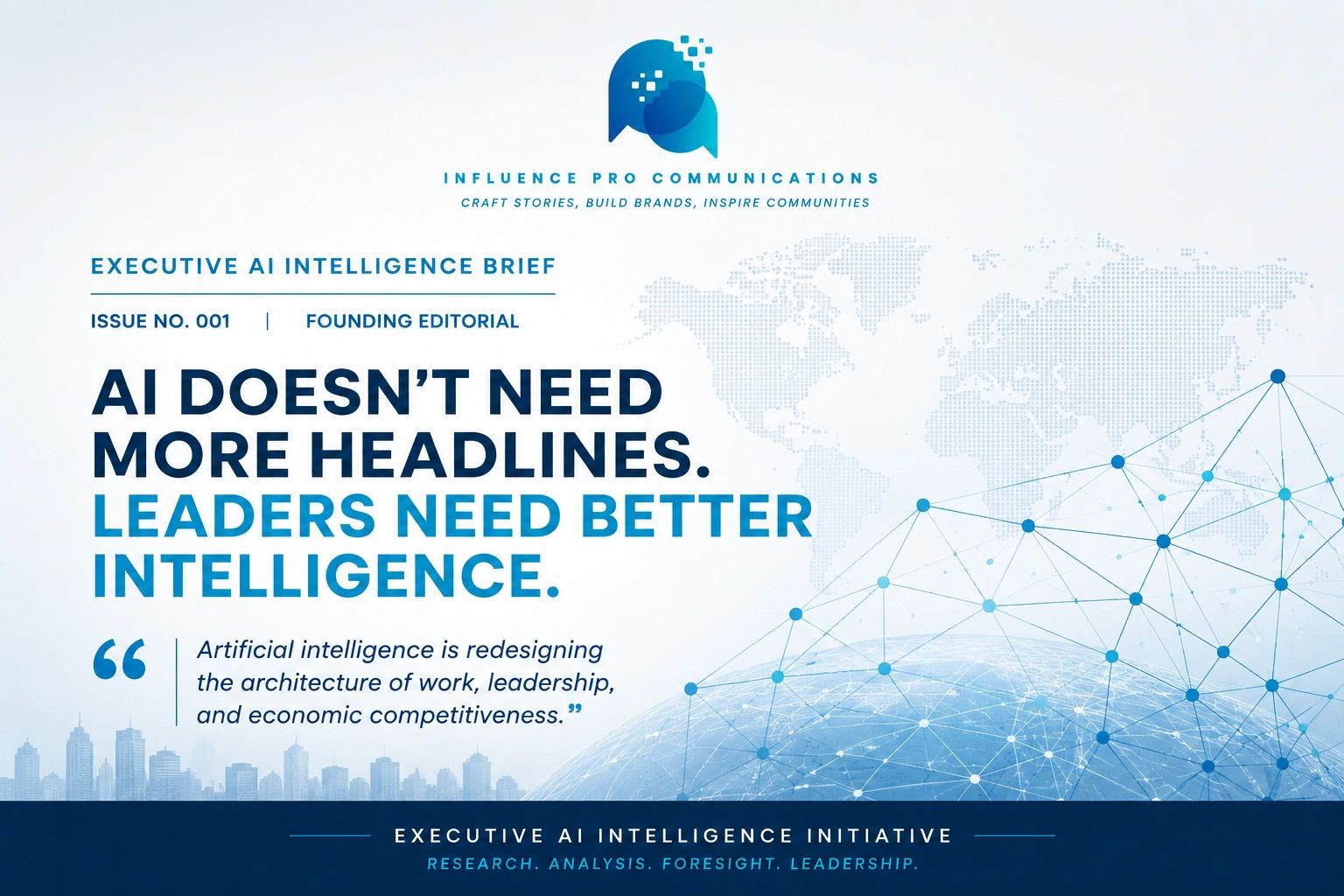
Issue No. 001 | Founding Editorial
AI Doesn't Need More Headlines. Leaders Need Better Intelligence.
Artificial intelligence has become one of the fastest-adopted technologies in history. Every week brings another announcement of breakthrough capabilities, billion-dollar investments, workforce reductions, or bold predictions about the future of work.
In response, many organizations rushed to deploy AI. Some reduced headcount. Others announced sweeping productivity gains before fully understanding how AI would reshape workflows, decision-making, customer experience, or organizational culture. In several well-publicized cases, companies later adjusted course after discovering that implementation proved far more complex than anticipated.
The lesson isn't that AI failed.
The lesson is that leadership matters more than ever.
Technology can automate tasks.
It cannot redesign organizations.
It cannot build trust.
It cannot develop strategy.
It cannot manage change.
Those responsibilities remain firmly in the hands of leaders.
The next phase of artificial intelligence will not be won by organizations that simply deploy new tools first. It will be won by those capable of redesigning work itself.
That means rethinking workflows.
Redefining roles.
Preparing employees.
Developing governance.
Building public trust.
Creating new measures of productivity.
Investing in education.
And perhaps most importantly, helping leaders make informed decisions in an environment changing faster than most organizations have ever experienced.
This is what I believe is emerging as the Implementation Gap.
The technology is advancing rapidly.
Leadership understanding is not.
Closing that gap may become one of the defining management challenges of the next decade.
The implications extend far beyond individual organizations.
Governments face new questions around workforce transition, education, economic competitiveness, infrastructure, regulation, public services, and national security.
Businesses must redesign how work is organized rather than simply automating existing processes.
Post-secondary institutions must prepare students for careers that continue evolving long after graduation.
Communities will need to adapt to economic disruption while identifying entirely new opportunities for growth.
Artificial intelligence is not simply another technology cycle.
It is redesigning the architecture of work, leadership, and economic competitiveness.
That requires something currently in short supply.
Executive Intelligence.
Not more headlines.
Not more hype.
Not another list of AI tools.
Leaders need research that synthesizes developments across technology, economics, public policy, education, geopolitics, and organizational leadership into practical strategic insight.
That belief has led us to begin building the Executive AI Intelligence Initiative at Influence Pro Communications.
Our objective is straightforward:
To help executives, governments, educators, entrepreneurs, and organizations understand not simply what AI can do—but what it means, what comes next, and how thoughtful leadership can transform uncertainty into opportunity.
The organizations and communities that thrive won't necessarily be those with the most advanced technology.
They will be those with the clearest understanding of where the world is heading—and the courage to prepare before everyone else.
That is the work we've begun.
Looking Ahead
Future Executive AI Intelligence Briefs will examine:
- The AI Implementation Gap
- Government Readiness for the AI Economy
- Canada's Competitive Opportunity
- AI, Leadership and Organizational Design
- Workforce Transformation
- Executive Decision-Making in the Age of AI
© Influence Pro Communications | Executive AI Intelligence Initiative