Rethinking Retail Merchandising Through AI is!
By Paul McCrea
Every week, somewhere in Canada, a merchandising team gathers around a conference table to decide what will appear in next week's food flyer.
What products deserve the front page?
Which categories need support?
Which suppliers are funding promotions?
Where is inventory building?
What can deliver value for customers while protecting margin?
It's a process that has served retailers well for decades.
It also relies heavily on something that no longer has to carry the entire load.
Human memory.
Human experience.
Human intuition.
Those qualities remain incredibly valuable—but today they can be supported by something far more powerful.
Continuous intelligence.
A Process Built for Another Era
In many organizations, category managers are responsible for hundreds—sometimes thousands—of products.
They know their categories exceptionally well.
They understand supplier relationships.
They recognize seasonal trends.
They know their customers.
Yet every promotional decision is still constrained by one reality:
No individual can simultaneously process every variable affecting performance.
Historical sales.
Weather.
Transportation costs.
Inventory positions.
Regional buying behaviour.
Price elasticity.
Competitive activity.
Supplier funding.
Community events.
Economic conditions.
The amount of information available has simply outgrown the human ability to connect every relationship.
That isn't a criticism of people.
It's an opportunity for AI.
What If the Workflow Changed?
Imagine a merchandising engine that never stops learning.
Every day it evaluates every product across every category.
It identifies emerging trends before they become problems.
It recognizes declining sales weeks before they appear in a report.
It understands which promotions truly generate incremental sales and which simply shift purchases from one week to another.
Instead of asking category managers to decide which products belong in the flyer...
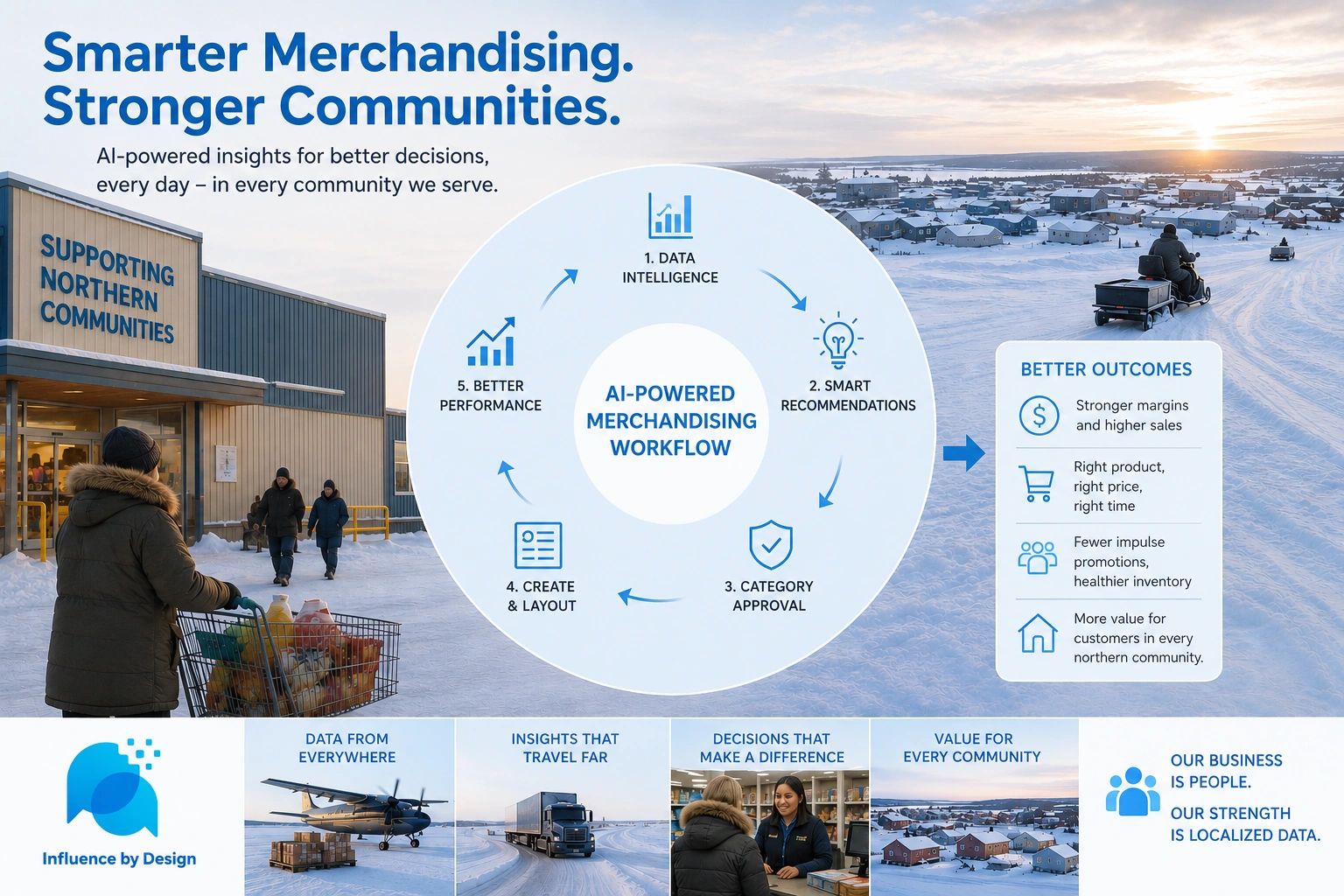
AI produces ranked recommendations based on hundreds of variables and the organization's strategic priorities.
The category manager doesn't lose control.
They gain clarity.
Instead of searching for answers...
...they evaluate the best ones.
Better Merchandising Creates Better Flyers
The interesting insight is that the weekly flyer isn't really the objective.
Better merchandising is.
When category performance is continuously monitored and optimized, fewer emergency promotions become necessary.
Products aren't promoted because inventory has suddenly become a problem.
Categories aren't discounted simply because performance weakened over the past two weeks.
Instead, AI identifies opportunities much earlier.
Small adjustments happen continuously.
Promotions become intentional rather than reactive.
The flyer becomes the reflection of a healthy merchandising strategy—not the tool used to rescue one.
From Weeks of Work to Hours
Now imagine what happens once those recommendations are approved.
AI prepares the promotional schedule.
It builds the first flyer layout.
It places products by category and promotional priority.
It writes consistent product descriptions.
It prepares digital versions.
It creates regional variations where needed.
It checks pricing consistency.
It flags potential errors before production.
What once required multiple teams working through numerous revisions becomes a workflow focused on review, refinement, and approval.
The work doesn't disappear.
It changes.
The Role of the Category Manager Evolves
One of the biggest misconceptions surrounding AI is that it replaces expertise.
The opposite is often true.
As AI takes on repetitive analysis, experienced merchants become more valuable.
Their role shifts from selecting products to evaluating strategy.
From assembling promotions...
...to asking better questions.
Does this recommendation support our long-term objectives?
Are we creating value for our customers?
Does this align with our brand promise?
Should local knowledge override the data?
Those are questions no algorithm should answer alone.
The Real Competitive Advantage
The greatest opportunity isn't saving time in flyer production.
It's building a merchandising organization that makes better decisions every day.
One that responds earlier.
Learns faster.
Identifies opportunities before competitors.
Reduces waste.
Improves inventory health.
Delivers greater value to customers.
And allows talented people to spend less time assembling promotions and more time shaping strategy.
Looking Ahead
For retailers serving diverse and geographically dispersed communities, merchandising has always required a delicate balance between data, logistics, customer needs, and experience.
Artificial intelligence doesn't replace that balance.
It strengthens it.
The future of retail won't belong to organizations that simply purchase AI tools.
It will belong to those willing to redesign the workflows behind their most important decisions.
The weekly flyer may seem like a small place to begin.
In reality, it may be one of the clearest windows into what the future of merchandising looks like.
And that future is closer than many people think.