
Building Discipline That Drives Results
Paul McCrea / Influence Pro Communications
In a world where disruption is constant and technology reshapes how we work, organizations often struggle not with vision, but with execution. That’s where a Basic Policy Framework (BPF) comes in.
A BPF is more than a set of guidelines—it’s a discipline system that ensures strategy translates into daily action. It aligns people, processes, and technology into a repeatable rhythm that keeps organizations focused, accountable, and adaptable.
What is a BPF?
At its core, a BPF:
- Defines the standards and policies that guide decision-making.
- Creates consistency across teams and functions.
- Builds accountability structures so execution doesn’t fall through the cracks.
- Enables adaptability when markets, technology, or customer expectations shift.
Think of it as an operating system for organizational effectiveness. Just as a computer OS keeps programs running in sync, a BPF keeps business functions aligned with strategy.
Why BPFs Matter Today
- AI & Automation – As organizations adopt AI, workflows can fragment unless guided by a clear framework. A BPF ensures technology supports strategy instead of creating silos.
- Workforce Transformation – Hybrid work models and generational shifts mean businesses need adaptable rules of engagement.
- Risk Management – Without structured policies, compliance gaps and reputation risks grow.
- Culture Building – A framework that embeds communication, training, and recognition creates a stronger culture of trust and performance.
When BPFs Go Right
A company with a strong BPF doesn’t waste time reinventing processes. Teams know what’s expected, decisions are made faster, and employees feel empowered because clarity replaces confusion. Execution becomes second nature.
One example is Toyota’s legendary production system. By embedding policies around continuous improvement and standardization, Toyota created a culture of discipline and innovation that has lasted decades.
When BPFs Go Wrong
Without a framework, even the biggest brands can stumble. Consider organizations that scaled quickly during the digital boom but collapsed under internal chaos—policies and workflows couldn’t keep up, and execution fell apart.
Gap’s failed logo rebrand, for instance, wasn’t just about design. It exposed the lack of a cohesive framework for decision-making and customer alignment. A BPF would have forced checks against customer insights before execution.
Introducing BPF 2.0
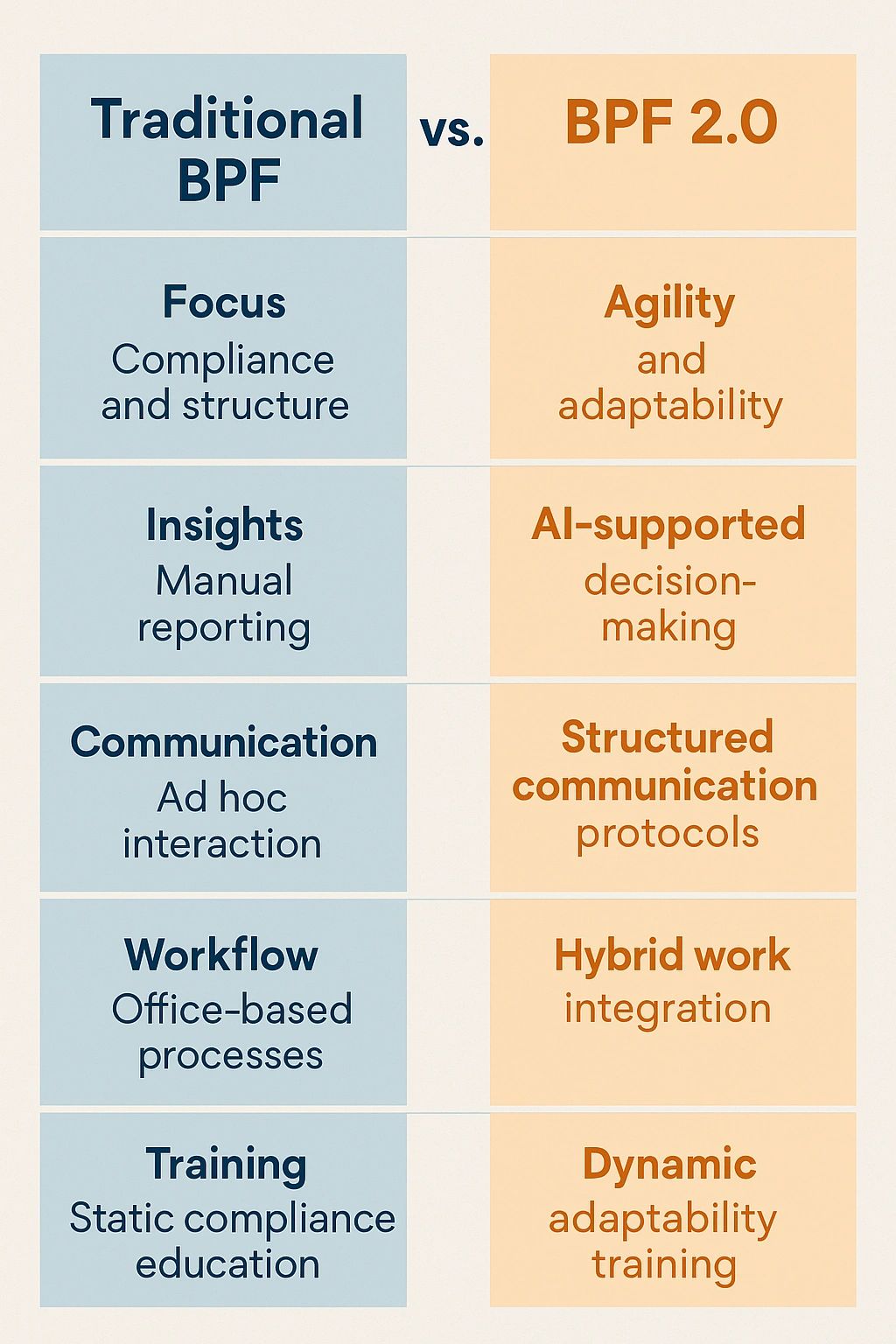
Traditional BPFs focused on compliance and structure. BPF 2.0, as we define it, is about agility and adaptability. It integrates:
- AI-driven insights to inform decision-making.
- Structured communication protocols to ensure transparency.
- Workflow policies that reduce friction in hybrid work.
- Training systems that embed adaptability as a skill.
In short, it’s not just about keeping order—it’s about enabling innovation while safeguarding consistency.
The Takeaway
In times of rapid change, businesses don’t fail because they lack vision. They fail because execution breaks down. A strong BPF provides the guardrails to keep strategy alive in the daily choices of every employee.
👉 If your organization is serious about growth, resilience, and adaptability, building (or upgrading) your BPF should be step one. Mastering AI Adaptability | Influence Pro Communications Inc.