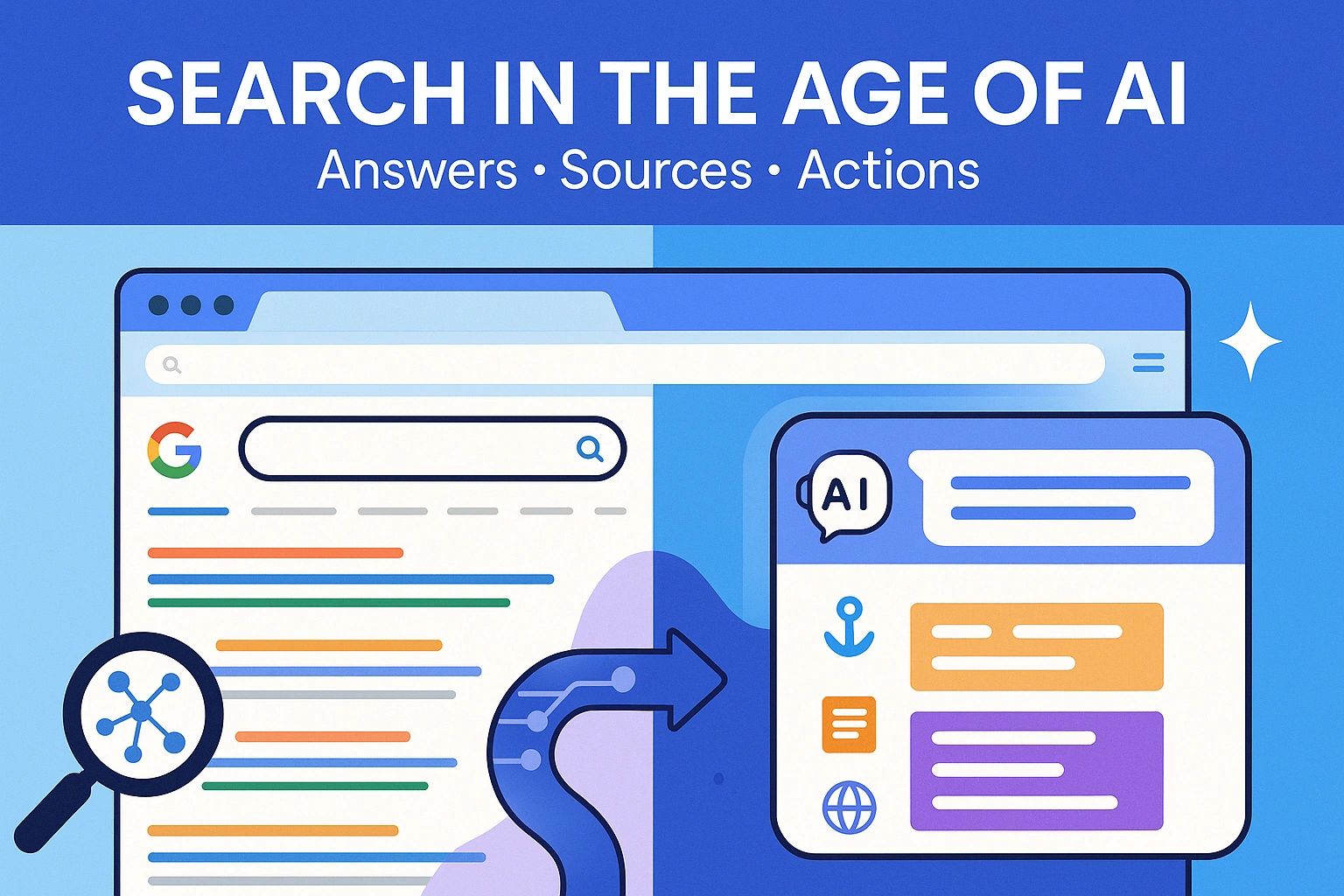
Search is being rebuilt in real time. Google is pushing Gemini deeper into Chrome and Search; AI-native engines like Perplexity are surging; and publishers are measuring real traffic shifts when AI answers appear on top of results. If your playbook still assumes ten blue links, it’s out of date.
What changed (fast)
Google is weaving Gemini into Chrome—AI help across tabs, a coming “AI Mode” in the address bar, and agentic features that can draft emails or complete tasks. That’s not a sidecar; it’s search and browsing converging.
Meanwhile, AI Overviews—Google’s summary boxes—have become the biggest variable in organic discovery. Industry groups report materially lower click-through when an Overview sits on top (e.g., DCN analysis and follow-on studies showing steep CTR drops on affected queries).
Fallout for publishers (and why it matters to brands)
When answers are summarized above the fold, fewer clicks flow downstream. Some publishers cite 1–25% declines in Google referrals; one media group recently sued Google over alleged misuse of journalism in AI Overviews and the resulting business impact. Even if lawsuits are unresolved, the direction of travel is clear: more answers on the page, fewer visits off the page. Marketers can’t ignore that.
The rise of AI-native search engines
Perplexity has quickly become the default “research” tab for many users: conversational answers with inline citations and file uploads. Estimates put it at ~22M MAUs and rapid traffic growth through 2025—a signal that “answer + sources” is a sticky pattern. Plan to be discoverable there, not just on Google.
Data deals are redrawing the content map
The training-data pipeline is formalizing. Reddit struck licensing agreements (and is renegotiating), and Stack Overflow partnered with OpenAI—two canaries showing that high-signal communities are being productized for AI experiences. For marketers, that means communities and Q&A ecosystems can become front doors to your expertise again—now via AI answers, not just forum threads.
What to do now (practical moves)
- Write “answer-first” pages. Lead with the 5-sentence executive answer your buyer actually needs, then deepen with methods, data, and visuals. This increases the odds your content is summarized accurately—and still compels a click for details. (Track: impressions vs. clicks on queries showing AI boxes.)
- Cite your sources (and create them). AI-era engines reward verifiable claims. Publish lightweight primary data—benchmarks, mini-studies, customer aggregates—and link out to reputable sources. Engines like Perplexity surface citations; be one.
- Own more first-party surfaces. Email, SMS, community, and downloads are insurance when intermediary clicks shrink. Treat search as the top of an owned-audience funnel, not the funnel itself.
- Diversify “search.” It now includes YouTube, Reddit, TikTok, and AI engines. Repurpose your answers as shorts with on-screen captions and chaptered descriptions—so you’re discoverable wherever the query happens.
- Mark up your content. Keep schema/structured data clean (FAQ, HowTo, Product). Even if it doesn’t prevent summarization, it helps models extract correct facts (and can improve rich results).
- Monitor the new metrics. Track “queries with AI answers,” CTR deltas, brand mentions inside summaries, and answer accuracy for your pages. Create a lightweight QA cadence to correct hallucinated claims.
The bottom line
AI is turning search into answer retrieval + task completion. That shrinks passive traffic but rewards brands that publish crisp, verifiable answers, seed primary data, and build owned audiences. Update your content and measurement with this reality in mind—because the changes aren’t hypothetical; they’re in the browser, on the SERP, and in your analytics today.