What “Cheap Productivity” Really Means
The story of AI at work isn’t a single big bang. It’s a rolling wave. In the next 24 months, most desk workers will gain an AI copilot inside everyday tools. In 2–5 years, many workflows will be automated end-to-end with humans in the loop. By 5–10 years, the most competitive organizations won’t “use” AI—they’ll be built around it.
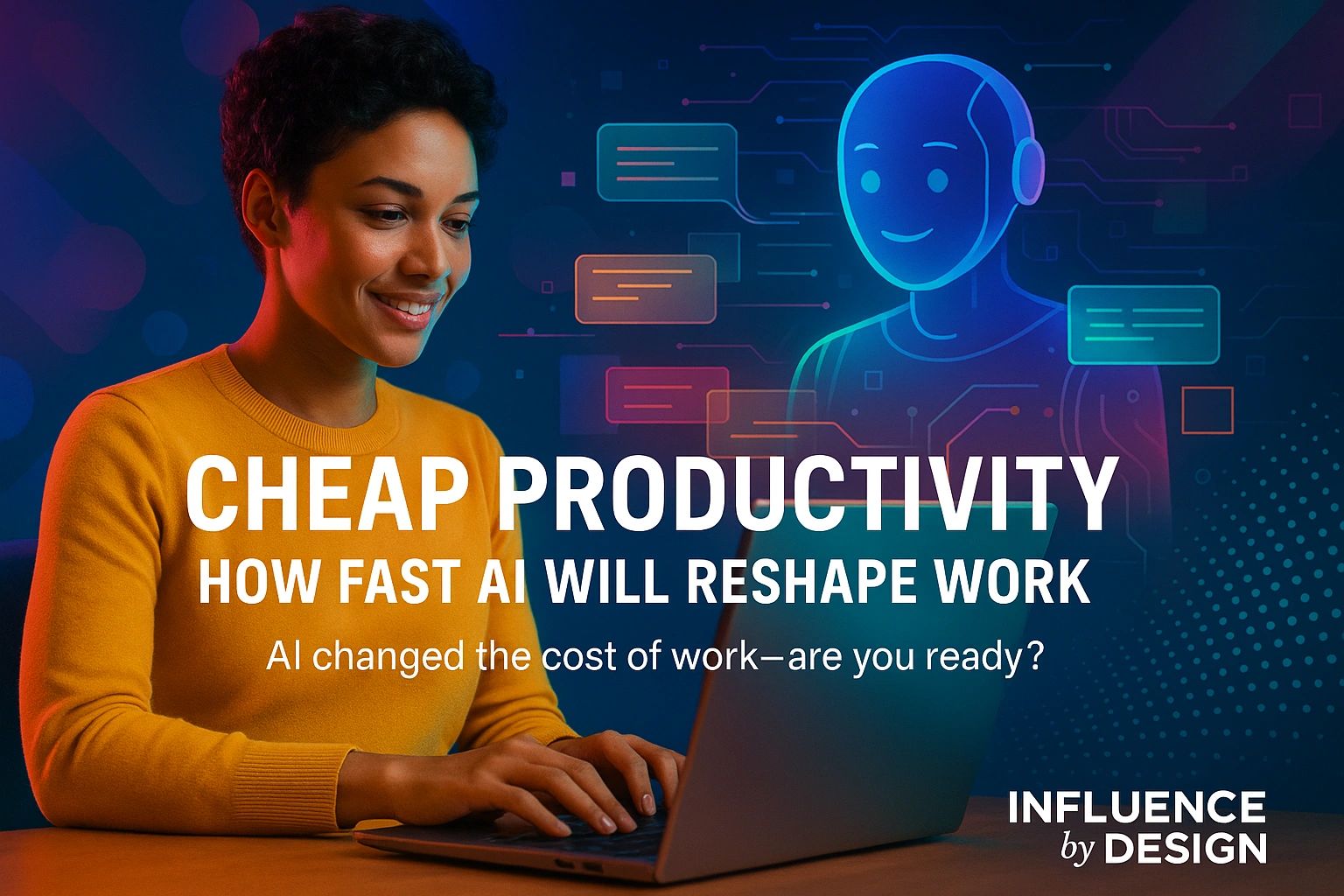
At the heart of this shift is cheap productivity: when AI slashes the marginal cost of making an email, a report, an image, an analysis, or a prototype, we don’t just do the same amount faster—we do 10x more. Markets flood with output, “good enough” becomes abundant, and value shifts from doing the thing to deciding, verifying, and orchestrating the right things.
The Timeline (What Changes When)
0–24 months: Copilotization.
Generative assistants embed in docs, sheets, inboxes, IDEs, CRMs. Drafting, summarizing, translating, analyzing—tasks shrink from hours to minutes. Teams iterate faster and try more ideas with the same headcount.
2–5 years: Automated workflows & agent teams.
Pipelines emerge: ingest → reason → draft → review → ship. Humans supervise the exceptions, guardrails, and decisions. Individual contributors manage work once done by small teams.
5–10 years: AI-first operating models.
Firms reorganize around data, evaluation, and orchestration. Entire functions—first-line support, basic research, standard reporting—run largely on AI with human accountability.
The Upside (if you’re ready)
- Massive productivity gains. More cycles, more experiments, better decisions.
- Democratized capability. Small teams access design, analytics, and localization that once demanded big budgets.
- Personalization at scale. Services, content, and learning adapt to individuals.
- 24/7 vigilance. AI catches anomalies humans miss—contracts, logs, compliance events.
The Downside (if you’re not)
- Commoditization of mid-tier work. When “good enough” floods the market, prices fall and margins compress.
- Quality drift. Fast output can hide shallow reasoning or hallucinated facts; verification becomes non-optional.
- Polarized talent ladders. Entry-level task work shrinks as premium shifts to system-level judgment.
- Data & IP leakage. Poor governance exposes customer data, trade secrets, and brand trust.
- Platform dependency. If a handful of vendors own the stack, they can set your costs—and your roadmap.
Cheap Productivity in Practice
Think of every recurrent artifact your org produces—emails, proposals, ads, briefs, dashboards, code, SOPs. AI compresses the cost and time of creation, so volume skyrockets. But the scarce things don’t: original data, taste, distribution, trust, and outcomes. That’s where advantage now lives.
- Content: Output is abundant; distinct insight and proof win.
- Services: Clients care less about hours and more about measured outcomes.
- Software: Many standalone tools become features; integrated platforms that combine data + workflow + evaluation dominate.
- Education: Value shifts from “produce the artifact” to “design the spec, evaluate the artifact, defend the decision.”
What to Do in the Next 18 Months
- Map your task portfolio. Rank tasks by frequency, cost, risk, and quality bar. Automate low-risk/high-volume first.
- Standardize a human-in-the-loop pipeline. Reusable prompts, approval gates, rubrics, and error logs.
- Secure your data. Decide what can/can’t go to models; prefer private/workspace deployments with audit trails.
- Differentiate with proprietary inputs. Capture interviews, support transcripts, operational logs—your unique data fuels defensibility.
- Upskill for specification and judgment. Train teams to define acceptance criteria, run experiments, and critique outputs.
- Measure outcomes, not vibes. Track cycle time, cost per experiment, error rates, and business KPIs—then reinvest gains.
The Forecast in One Line
AI collapses the cost of creation; advantage moves to specification, verification, and orchestration—and to the data and trust only you own.
Sidebar: How to Protect Your Brand in
the Era of Cheap Productivity
- Guardrails by design. Pre-approved prompts, red-team checklists, and “no-go” data rules.
- Provenance & watermarks. Label AI-assisted outputs; keep source logs for legal and client trust.
- Distinctive voice. Codify tone, style, and visual standards; require human edits on customer-facing work.
- Original data advantage. Build proprietary datasets; use them to fine-tune or ground your systems.
- Quality gates. Rubrics for accuracy, citations, bias checks, and brand safety—scored and auditable.
- Portfolio proof. Showcase outcomes (case metrics, before/after) rather than artifacts.
- Vendor resilience. Avoid single-vendor lock-in; keep portable prompts, datasets, and evaluation suites.
Social pull-quotes (ready for graphics)
- “AI didn’t just speed up work—it changed what counts as valuable work.”
- “When creation gets cheap, judgment becomes priceless.”
- “Your moat isn’t more content. It’s better data, stronger trust, and faster learning loops.”
- “The winners won’t ‘use’ AI—they’ll operate on it.”
Ready to build an AI-first workflow without losing your brand?
Influence by Design’s Mastering AI Adaptability shows you how to design prompts, pipelines, and guardrails that deliver real business outcomes. Book a strategy session or enroll today.